Composing a list
A list reads as a tool when its columns are the ones a person scans for and its tabs are the ways the work divides. Compass’s tasks are the worked example.
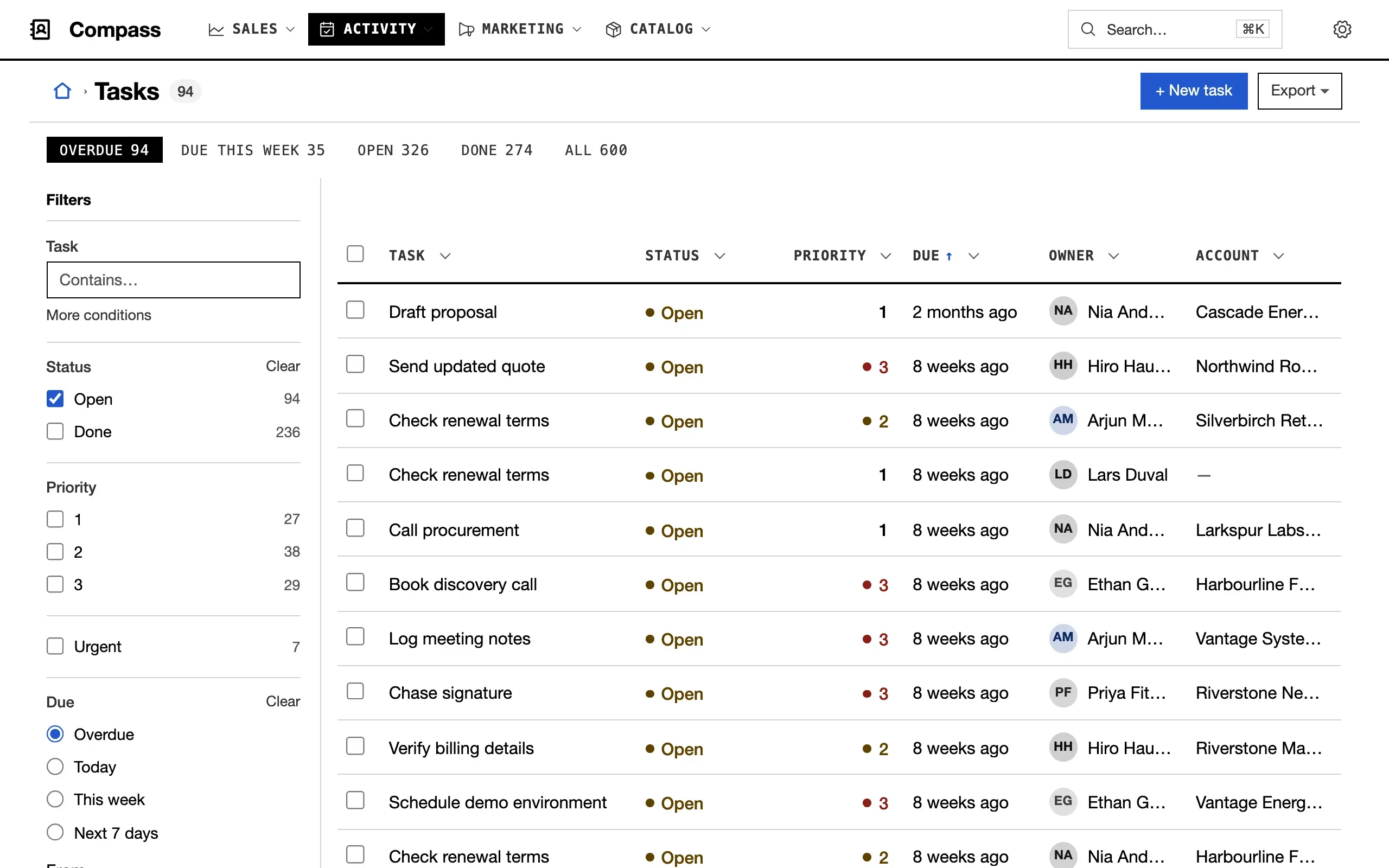
- Always,
show4–7 columns: the name first, then the state, the parent by name (owner_id.name), a figure and a date; never a raw id — compass/views.ts:67. - When the rows are people or companies, an
avatarand a mutedsubtitleon the first column — compass/resources.ts:27. - When the work divides by state or date,
tabsin the order it is worked, All last — views.ts:75. - When it is worked by narrowing on three or more facets,
filterBar: 'rail'— views.ts:73; fewer, the bar’s chips offilters— views.ts:14. - When triage happens in the list, make those columns
editable— views.ts:70. - When a record’s verbs are the work,
rowActions: true— views.ts:12. - When a figure adds up,
totalsunder the rows — views.ts:31; when a count or sum of children says more, a rollup such asopen_pipelineshown like a column — views.ts:45. - When it can be empty, an
emptythat says what belongs there and where it comes from — depot/views.ts:31. - When the rows are things to look at, a cards
presentation— forecourt/views.ts:17.
The keys are in Lists.